Wherever crude oil is extracted or processed, water is produced: process water, rainwater from paved surfaces, water from cleaning tanks and pipes. It almost always carries oil with it, often heavy oil, sand and sludge as well. If this mixture reaches soil or waterways unfiltered, the damage lasts for years.
This is exactly where AWAS FEE comes in: its plants separate oil and other pollutants from water so that the water can be reused or safely discharged. The separated oil is collected instead of ending up in the environment.
A life devoted to clean water
The story begins at a stream. As a small boy, Heinz Ihne found dead fish there, an experience that never left him. Clean water became his life's work. In the mid-1970s he founded AWAS, first developing individual products and later entire process lines to treat industrial wastewater and return it to the water cycle.1
The company in Wilnsdorf in the Siegerland region grew into a group with subsidiaries in Germany, Poland, Croatia, Romania, Ukraine, Russia and Switzerland, as well as offices in eleven further countries from Scandinavia to China.3 In 2017 the group founded AWAS FEE GmbH as its own research and development centre. The name stands for "Forschen und Entwickeln an der Evolution", researching and developing evolution.7 Heinz Ihne runs AWAS FEE today as managing director.10
Clean water is not a by-product. It is the goal.
The galaxy principle
At its heart is the Galaxie separator, a patented AWAS module. Its principle of motion is derived from galaxies: the vortex separator separates oil, sand, sludge and water at the same time and discharges the separated substances automatically.1 The large Galaxie plants range from over 100 to over 1,000 litres per second.2
- Inflow. The water flows into the plant in a controlled way so that oil and solids can separate from each other.
- Separation. Oil rises to the top and is skimmed off, while sand and sludge settle at the bottom.
- Recovery. What remains is treated water, and an oil stream that can be reprocessed.
According to TÜV testing, the Galaxie Tower typically achieves these values: around 95 percent of sand particles above 100 micrometres are retained, and free oil falls from 200 to below 10 ppm. It needs no chemicals, no rotating parts and no energy to do so.8 This approach runs through the entire company history: working mechanically and physically wherever possible and largely avoiding additives.7
Where AWAS technology is at work
The map shows the countries for which there is public evidence of AWAS projects, and the countries with subsidiaries or offices of the group.
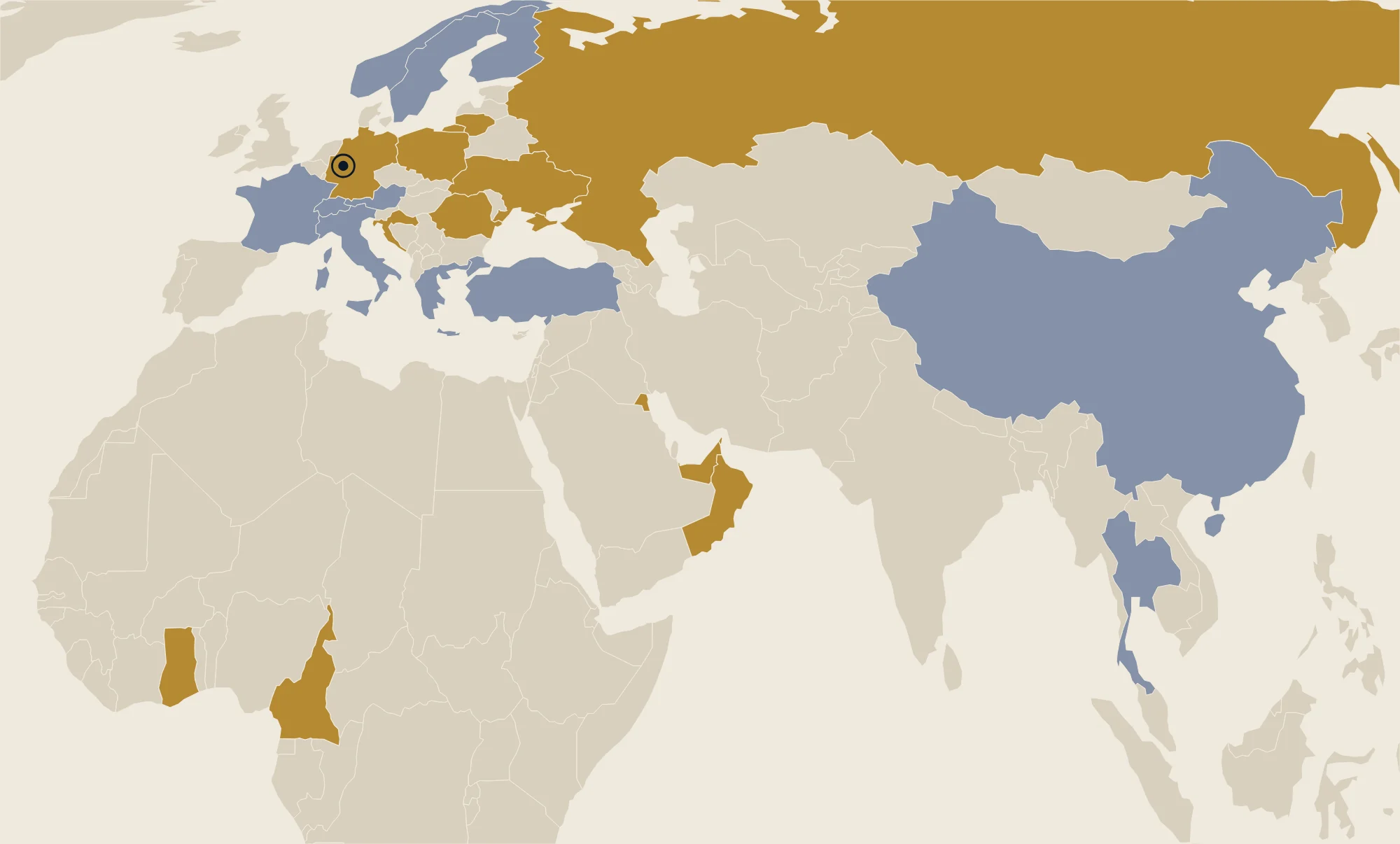
- Documented projects (12 countries)
- Subsidiary or office (11 further countries)
- Headquarters in Wilnsdorf
How many plants have been built in total is not publicly documented. The map therefore only shows countries for which evidence exists.
Selected references
- Oman · Oil production: Together with the Austrian partner Sonnek, an AWAS Galaxie Tower for 5,000 m³ per hour was used as the first separation stage for produced water.8
- Oman · Nimr: According to AWAS FEE, the large Galaxie plant follows the model of the PDO project in the Nimr desert. That is where the world's largest separator plant stands, designed by Heinz E. Ihne for Bauer Resources.2 Since 2010 the Nimr plant has treated around one billion barrels of produced water and recovered more than half a million barrels of oil. The treated water created a wetland that today provides habitat for almost 100 bird species.9
- Oman · Airport: At an airport in Oman, AWAS delivered the treatment of heavy rainwater and the separation of oil and light liquids.1
- Ghana: For the edible oil producer Ghana Nuts, AWAS built a plant that treats around 60,000 litres of wastewater a day and returns most of it to production. The project was supported by DEG with funds from the German development ministry's develoPPP programme. It also included a public drinking water well intended to supply, among others, a hospital that was under construction at the time.7 In the joint project "Rain", AWAS was a partner for using rainwater in the drought-stricken country.1
- Cameroon: AWAS sponsored and fully financed drinking water plants in Leffe.7
- Europe · Industry: Numerous industrial projects in Germany, Poland, Russia and Croatia4 as well as dozens of filling stations and fuel facilities in Poland, Germany, Romania, Lithuania, Ukraine and Russia.5
- Military: Numerous projects for military facilities in Poland, Germany, the United Arab Emirates and Kuwait.6
- Research: In the Autartec research project with Fraunhofer IKTS and BTU Cottbus-Senftenberg, AWAS developed the water treatment for a self-sufficient floating house, where greywater is to reach service or drinking water quality again.7
A project on a large scale
The team is currently supporting a project in one of the largest refineries in the Middle East. It shows what matters: a robust plant, a clear operating manual for the staff on site and careful documentation of every event outside normal operation.
At the same time, the team is examining extensions, such as a separate module for oil and sludge streams that relieves the main plant. Such ideas are only implemented after technical review.
Why this belongs in the Lighthouse Magazine
The Nature section shows projects that protect the environment and close cycles. AWAS FEE is the first of them: half a century of experience, plants on three continents and an idea that sounds as simple as it is hard to achieve: oil out, water back. Anyone facing a similar task, in a refinery, a port, an airport or an industrial plant, can get in touch via Lighthouse Projects International.
Sources
- Wirtschaftsforum: "Mit der Natur. Für die Natur." Interview on AWAS International GmbH (German)
- AWAS FEE GmbH: Services and large Galaxie separator plants (German)
- AWAS: About us, company profile with subsidiaries and offices
- AWAS: References, industrial installations
- AWAS: References, filling stations and fuel depots
- AWAS: References, military facilities (Polish)
- Wikipedia draft: AWAS group (German)
- Sonnek: Water Injection, SONNEK & AWAS Galaxie Tower (PDF)
- Times of Oman: Oil and gas companies in Oman go green
- AWAS FEE GmbH: Legal notice (German)